Solutions
Industries
Regulations
Resources
Company



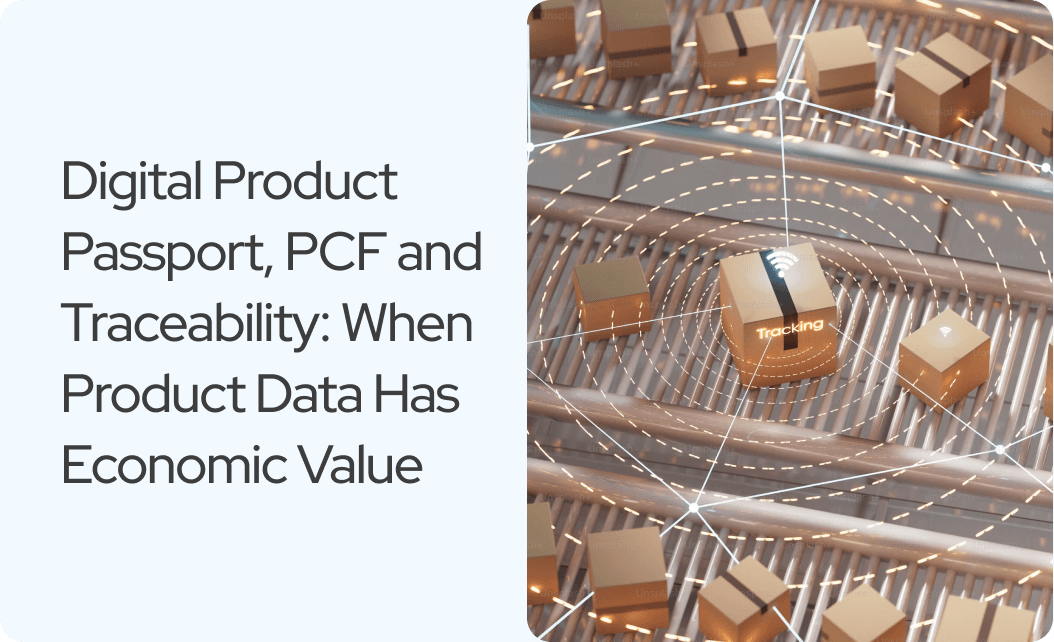
As sustainability becomes a key driver for businesses, the need for products to carry detailed sustainability labels is growing rapidly. Initially, this starts with Product Carbon Footprint (PCF) data, but it will soon expand to include various certificates and sustainability claims. In the world of sustainability, however, the data you rely on doesn’t end with your own numbers. It extends far beyond that—it’s critical to track what your suppliers are doing and ensure that the data can be passed along to your customers in a way that maintains its integrity.
Previously, many companies relied on emails, spreadsheets, and forms to gather this data from suppliers. Often, these methods were inefficient, prone to errors, and lacking transparency. Companies might have vaguely claimed to have collected data without fully verifying or tracking it. But as sustainability claims and labels become more prominent, the level of accountability required is rising. Companies will need to not only track the data they’ve received but also communicate the exact percentage of primary data (from suppliers) versus secondary data sources. This is the level of granularity that’s now needed for sustainability labels to hold weight.
With the advent of the EU Claims Directive and the EU Sustainable Product Regulation (ESPR), businesses are now legally required to substantiate and verify their sustainability claims with accurate, traceable data. These regulations emphasize the need for transparent communication, compelling companies to go beyond vague data and use robust systems that trace the entire lifecycle of a product’s sustainability data.
The question arises: Are traditional tools capable of managing this kind of data traceability? Even newer technologies, which offer fancy dashboards and report generation, may fall short when it comes to maintaining traceability across the entire data supply chain. True traceability demands more than just collecting data—it requires a robust system that ensures data flows seamlessly and securely between stakeholders while maintaining integrity. A well-designed PCF Data Exchange is critical in this scenario.
In today’s landscape, traditional tools such as emails, spreadsheets, and even basic software aren’t equipped to handle the evolving demands of sustainability labeling. With more complex data flows and a greater need for traceability, companies need automated systems that ensure accuracy and transparency. Here’s how technology can help:
The complexity of sustainability data, especially when sourcing it from multiple suppliers, requires the ability to track and verify where data is coming from. A PCF Data Exchange platform helps track the origin of data and how it flows from suppliers to businesses and ultimately to customers. This enables companies to not only claim they’ve gathered data but also demonstrate the provenance and accuracy of that data.
Managing large volumes of sustainability data manually is both time-consuming and error-prone. Automated systems streamline the collection, validation, and sharing of PCF Data Exchange data, ensuring that what’s reported is both accurate and traceable. Automation helps eliminate discrepancies, making it easier to manage and track data as it moves through the supply chain.
Standardizing data formats and ensuring compatibility across various systems is crucial for traceability. As more stakeholders become involved, companies need technology solutions that can seamlessly integrate with different IT infrastructures and sustainability tools. This ensures that data is harmonized across systems, reducing inconsistencies and improving collaboration, all of which is supported by an effective PCF Data Exchange system.
With technology in place, businesses can gain real-time insights into their PCF Data Exchange and track progress against sustainability targets, identifying areas for improvement. For example, a tool like Carboledger offers real-time analytics that helps identify hotspots within the supply chain and provides actionable data that drives more sustainable decisions.
Protecting sensitive supplier and operational data is a top priority. As sustainability claims gain importance, businesses must ensure that data is shared securely. Technology can provide encryption, access control, and compliance with international standards, ensuring that data privacy is maintained throughout the PCF Data Exchange process.

Carboledger is a digital solution designed to meet these challenges head-on. It automates data collection and verification, integrates seamlessly with existing systems, and ensures real-time traceability of PCF Data Exchange data from suppliers to customers. The platform’s ability to track the source and flow of data is crucial for meeting the evolving demands of sustainability labels and the requirements set by the EU Claims Directive and the EU Sustainable Product Regulation (ESPR).
With Carboledger, businesses can:
As the demand for sustainability labels grows, so too does the need for better, more transparent data management. The future of product labeling and sustainability claims lies in the ability to trace and validate data throughout the supply chain. Traditional methods are no longer sufficient—companies need advanced technology solutions like Carboledger to automate, validate, and trace PCF Data Exchange, ensuring the credibility and accuracy of their sustainability claims, while meeting the evolving regulatory standards like the EU Claims Directive and EU Sustainable Product Regulation (ESPR).
Ready to move beyond spreadsheets and emails? Explore how Carboledger can help you build a more sustainable, transparent, and traceable PCF Data Exchange system for your products.