Solutions
Industries
Regulations
Resources
Company


Key takeaways
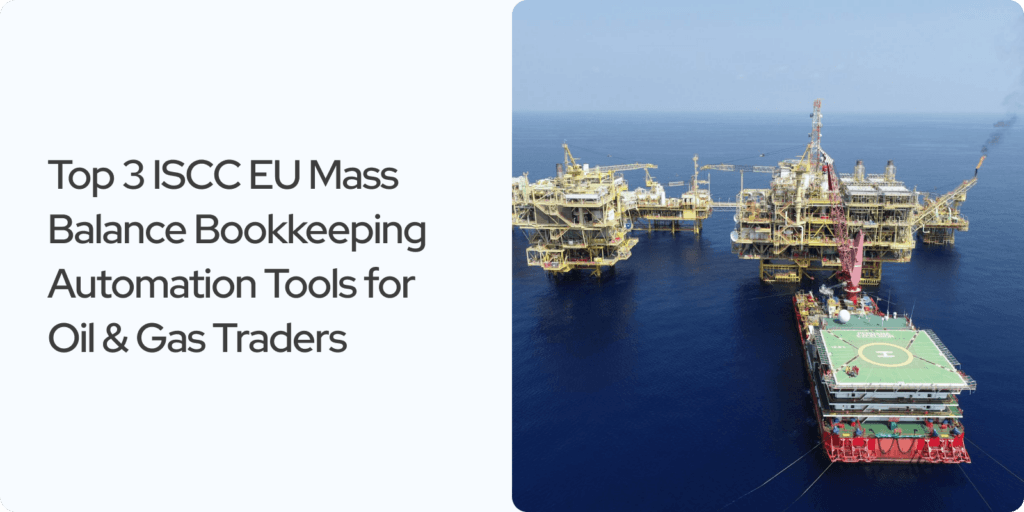
As ISCC EU certification grows, oil & gas traders face increasing complexity in managing mass balance bookkeeping. Unlike static environments, trading operations involve forward contracts, split cargos, terminal movements, and continuous alignment between shipments and sustainability data.
This makes mass balance a trade-driven, real-time process, not just a month-end reconciliation task. Traditional tools often struggle to handle this level of complexity.
In this article, we review the top ISCC EU mass balance automation tools for 2026, focusing on how well they support real trading workflows and compliance needs.
For oil & gas traders, ISCC EU mass balance is not simply about reconciling inputs and outputs at month-end. Data tracking begins at the trade, including forward contracts, partial deliveries, cargo splits, terminal transfers, and registry submissions.
The tools below are evaluated based on how well they support real trading workflows, not just static ledger management.
In addition to core ISCC EU requirements, tools were assessed based on trader-specific realities:
| Rank | Tool | Best suited for | Trading workflow support | Registry & UDB readiness | Flexibility | Key limitations |
| 1 | Carboledger Smart Balance | Active multi-terminal traders | Contract-linked, cargo-level | Direct UDB connectivity | High | May require setup time to accommodate custom workflows |
| 2 | Circularise | Structured traceability environments | Ledger-driven | Direct UDB connectivity | Moderate | Immutable design limits post-issuance flexibility |
| 3 | Track & Certify Enterprise® by EUFEX | Established registry-centric workflows | Registry-aligned | EU-focused | Moderate | Less flexibility for evolving trading workflows |
Best for active oil & gas traders managing complex cargo flows
Carboledger Smart Balance supports ISCC EU mass balance from the trade lifecycle onward, linking contracts, shipments, SD issuance, and registry reporting in one structured system.
For traders managing forward trades, partial deliveries, and multi-terminal movements, this linkage reduces the risk of allocation mismatches.
Best for structured ISCC EU traceability in trading environments
Circularise supports ISCC EU compliance and offers direct UDB connectivity, focusing on structured and tamper-resistant recordkeeping.
It performs best when trading flows are stable and do not require frequent post-issuance adjustments.
Because records are designed to be immutable, handling post-issuance changes — such as cargo reallocations or SD corrections — can be more constrained in active trading environments.
Best for registry-centric ISCC EU implementations
Track & Certify Enterprise® by EUFEX is positioned around structured registry alignment and EU-focused sustainability reporting.
It supports general ISCC EU mass balance requirements but is less specialised in managing forward trades, forecasting logic, or complex contract-level adjustments.
For oil & gas traders, ISCC EU mass balance is inseparable from trading operations. The risk is not just in the ledger, it is in how contracts, cargos, and sustainability characteristics are linked over time.
As trader certifications continue to represent a large share of ISCC EU certificates, automation must extend beyond reconciliation to support the full trading lifecycle.
Choosing a system built for cargo-level complexity and regulatory alignment is increasingly essential for maintaining compliance integrity in EU-regulated fuel markets.
Disclaimer:
Carboledger Inc. is an independent software provider. References to ISCC or any other certification schemes in this article are made solely for informational and educational purposes. Carboledger is not affiliated with, certified by, or endorsed by ISCC System GmbH or any certification body. The content does not constitute certification advice or official guidance.