Solutions
Industries
Regulations
Resources
Company


Key takeaways
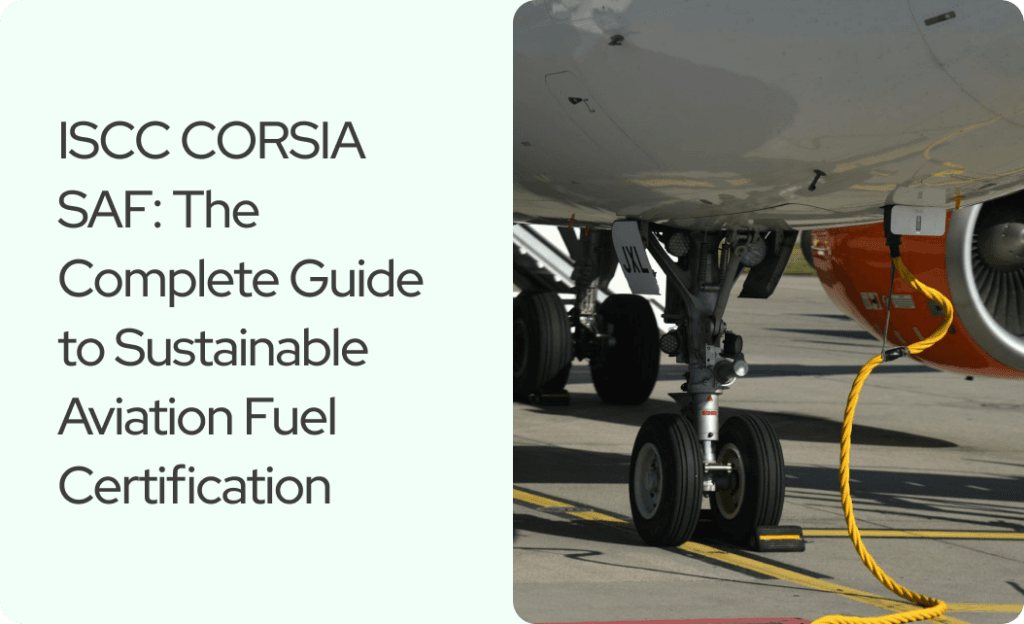
The aviation industry is under growing pressure to cut carbon emissions, and sustainable aviation fuel (SAF) is at the center of that transition. But not all SAF qualifies for international carbon offsetting programs. That’s where ISCC CORSIA SAF certification becomes essential.
ISCC (International Sustainability and Carbon Certification) is one of the most widely recognized sustainability certification systems approved under CORSIA — the Carbon Offsetting and Reduction Scheme for International Aviation, managed by ICAO. For fuel producers, airlines, and supply chain actors in the US and globally, understanding ISCC CORSIA SAF requirements is critical to compliance, market access, and credibility. This guide breaks down everything you need to know in clear, practical terms.
CORSIA is ICAO’s global framework requiring international airlines to offset CO₂ emissions that exceed 2019 baseline levels. To qualify for carbon credits under CORSIA, SAF must be certified by an approved sustainability scheme — and ISCC is one of the primary approved schemes.
ISCC CORSIA SAF certification verifies that a fuel meets strict lifecycle greenhouse gas (GHG) reduction thresholds, traceability standards, and sustainability criteria. Without this certification, SAF cannot generate CORSIA Eligible Emissions Units (CEEUs), meaning airlines cannot use it to meet their CORSIA obligations.
For US-based producers, blenders, and airlines, the stakes are high. As CORSIA’s offsetting obligations scale up through 2035, demand for properly certified SAF is accelerating sharply.
ISCC operates two relevant schemes: ISCC EU (for EU regulations) and ISCC CORSIA (specifically for ICAO’s aviation program). ISCC CORSIA is tailored to meet the CORSIA Sustainability Criteria, which were developed jointly by ICAO and fuel sustainability experts.
To obtain ISCC CORSIA SAF certification, operators must demonstrate:
Not every feedstock qualifies. ISCC CORSIA SAF accepts a defined list of approved feedstocks, which must meet CORSIA’s default or actual GHG values. Common qualifying feedstocks include:
Each feedstock carries a different lifecycle GHG emissions value. Producers must calculate actual GHG savings or use ICAO-approved default values published in the CORSIA Eligible Fuels document, updated annually.
ISCC CORSIA certification is not self-declared — it requires an independent third-party audit by an ISCC-approved certification body. The process typically involves:
US producers seeking ISCC CORSIA SAF status should expect the initial certification process to take 2–4 months, depending on supply chain complexity.
The CORSIA framework requires SAF to achieve a minimum 10% lifecycle GHG reduction versus conventional jet fuel. In practice, most certified SAF pathways achieve 50–90% reductions, which is why ISCC CORSIA SAF commands significant market premiums.
The GHG calculation must follow ICAO’s CORSIA methodology, which accounts for:
ISCC CORSIA uses a mass balance chain of custody model. This means certified and non-certified volumes can be physically mixed in storage or processing, as long as the certified quantities are accurately tracked in documentation. This is particularly important for fuel blenders and airport fuel facilities managing multiple fuel streams.
Carbon reduction is the headline, but ISCC CORSIA SAF also evaluates:
These criteria align with international standards like the UN SDGs and ILO conventions, making ISCC CORSIA SAF suitable for ESG reporting frameworks as well.
ISCC CORSIA certification is relevant across the entire SAF value chain:
If your organization is involved at any point between raw feedstock and jet fuel combustion, ISCC CORSIA SAF compliance likely touches your operations.
Getting certified doesn’t have to be overwhelming. Here are practical steps to streamline the process:
As global aviation carbon regulations tighten, ISCC CORSIA SAF certification is no longer optional for serious players in the sustainable fuel market. It’s the standard that connects feedstock producers, refiners, blenders, and airlines to a credible, internationally recognized compliance framework — and it’s the gateway to the growing market for carbon-accountable aviation fuel.
Whether you’re a US-based SAF producer exploring certification for the first time or an airline building a compliant supply chain, understanding ISCC CORSIA requirements gives you a decisive edge. Platforms like Carboledger help organizations across the SAF value chain manage the complexity of sustainability data, mass balance accounting, and certification documentation — so you can focus on scaling your impact, not wrestling with spreadsheets. Start your ISCC CORSIA SAF certification journey with the right tools and the right knowledge.
ISCC CORSIA SAF refers to sustainable aviation fuel that has been certified under the ISCC CORSIA scheme — an internationally recognized standard approved by ICAO. It confirms that the fuel meets lifecycle GHG reduction requirements and sustainability criteria needed for airlines to claim CORSIA compliance credits.
CORSIA requires a minimum 10% lifecycle GHG reduction compared to conventional jet fuel (baseline: 89 gCO₂eq/MJ). However, most certified SAF pathways achieve 50% to 90% reductions, which drives higher market value and stronger sustainability claims.
Not for all SAF domestically, but it is required for SAF used to meet CORSIA obligations on international flights. Airlines operating international routes governed by CORSIA must use CORSIA-eligible fuels, making ISCC CORSIA SAF certification commercially necessary for that market segment.
An ISCC CORSIA certificate is valid for one year from the date of issuance. Annual surveillance audits are required to maintain certification. Organizations should plan recertification timelines well in advance to avoid lapses in compliance status.
ISCC EU is designed to meet European Union renewable energy and fuel directives (like RED II). ISCC CORSIA is specifically structured to satisfy ICAO’s CORSIA Sustainability Criteria for aviation. While they share foundational principles, the GHG methodologies, eligible feedstocks, and applicable regulations differ between the two schemes.