Solutions
Industries
Regulations
Resources
Company


Key Takeaways
In the previous blog, I wrote about the rather strange economics of used cooking oil. Two fuels can perform essentially the same physical function and still have very different economic values because one carries a regulatory characteristic that the other does not. Once a buyer needs that characteristic to meet an obligation, knowing the feedstock, origin, GHG intensity and certification of the fuel is no longer a sustainability-reporting exercise. It becomes part of knowing what you are actually buying.
Biofuels are a particularly mature example of this, but I don’t think the idea is going to remain confined to fuels. Across Europe, more environmental information is beginning to matter at the level of products and transactions themselves. CBAM makes embedded emissions relevant to the economics of importing certain goods. Recycled-content requirements can make the origin of material inside a product commercially important. Product carbon footprints increasingly travel between suppliers and customers. The Ecodesign for Sustainable Products Regulation introduces the Digital Product Passport as infrastructure through which information about products can be made available across value chains.
The interesting shift, at least to me, is not that companies suddenly have to collect more sustainability data. We have been doing that for years. It is that some of this information can now change what a product is worth, where it can be sold, whether it satisfies a requirement or what somebody further down the value chain is willing to pay for it.
Once that happens, the data is no longer sitting next to the product. It starts becoming part of the product’s economic identity.
There is actually nothing particularly revolutionary about this idea. Commodity markets have always distinguished products using characteristics that aren’t immediately obvious to the person looking at them. Crude oil is priced differently depending on sulphur content and density. Agricultural commodities have grades and origins. Metals have specifications. Electricity can have different contractual characteristics even though the electrons arriving at a socket are indistinguishable.
Markets do this because those characteristics affect utility, processing cost, scarcity or what a buyer can do with the product. Once a characteristic matters economically, systems emerge to measure it, standardise it and communicate it between buyer and seller.
Take steel. Two tonnes may satisfy the same mechanical specification and perform the same function in a building or a car, but they can have very different embedded emissions depending on how they were produced. Historically, that difference might have appeared in a sustainability report or an LCA and had little bearing on the transaction itself. If a customer has a low-carbon procurement target, a product-level carbon requirement or an economic exposure linked to embedded emissions, the distinction starts affecting purchasing decisions.
The same logic applies to chemicals. Two tonnes of chemically identical material can come with very different product carbon footprints depending on feedstock, energy source, production route and allocation. If the downstream manufacturer is trying to reduce the footprint of its own product, supplier-specific carbon data can influence which tonne it wants to buy.
What has changed is not the physical existence of these differences. They were always there. What is changing is the number of situations in which somebody has an economic reason to care about them.
CBAM is perhaps the cleanest example because it connects environmental information directly to trade economics. An importer of a covered product doesn’t merely need to know how many tonnes it imported. The embedded emissions associated with those tonnes matter to the regulatory treatment of the import.
That changes the role of carbon data rather dramatically. If two suppliers offer the same underlying product at the same commodity price but one has materially lower embedded emissions, their offers may no longer have the same effective economics for an EU importer. A number that might once have lived in an annual carbon inventory can now affect a transaction.
This is a very different world from sustainability disclosure. In a disclosure regime, the primary question is whether the company has accurately described its environmental performance. In a transactional regime, the question becomes whether the environmental characteristic attached to a specific product is accurate enough to support a commercial or regulatory consequence.
The incentive structure changes accordingly. If reporting a lower number improves the economics of my product, I have a reason to want the lowest defensible number. My customer has a reason to know whether that number is credible, while a regulator has a reason to prevent companies from gaining an advantage through claims that cannot be substantiated.
We are back to the same pattern we saw with biofuels: regulation creates economic value for a characteristic, and economic value creates a need for evidence.
There is a temptation to discuss the Digital Product Passport as though it were primarily a new QR code companies will have to put on products. I think that misses the more interesting question.
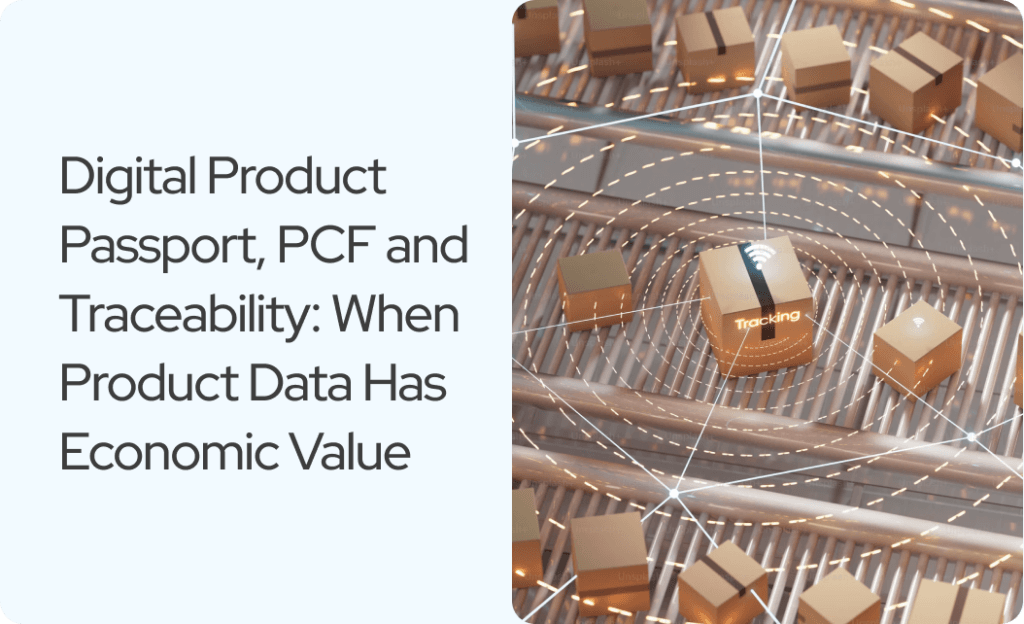
Under the Ecodesign for Sustainable Products Regulation, the DPP is intended to provide access to product information electronically, with the exact information requirements depending on the product rules developed under the regulation. The broader ESPR framework can address characteristics such as durability, repairability, recycled content, resource use and environmental footprints. Europe has already identified priority product groups under its implementation work, while batteries have their own passport requirements under the Battery Regulation.
Not every DPP datapoint will have direct economic value and it would be a mistake to treat every possible sustainability characteristic as though buyers are suddenly going to pay a premium for it. Some information will exist because regulators need it, some because consumers or repairers need it, some because recyclers need it and some because companies further down the supply chain need to satisfy their own requirements.
But the direction is interesting. Information that historically lived in company-level reports is moving closer to individual materials, components and products. The question is no longer only whether a company has a sustainability policy or what its annual emissions were. Increasingly, it can be what is inside this particular product, where it came from, how it was made and what environmental characteristics travel with it.
That creates a very different information problem.
If every company manufactured a product from raw materials it extracted itself, measuring these characteristics would be considerably easier. Modern industrial supply chains are obviously nothing like that. A manufacturer buys materials from suppliers, who buy intermediates from other suppliers, who may themselves aggregate materials from multiple sources. Products are converted, blended, stored, transported, split and recombined before reaching the final customer.
The company at the end of the chain often wants information that originates several tiers upstream from it.
This is why product carbon footprinting so quickly turns into a supplier-data problem. The downstream company can calculate using secondary datasets and assumptions, but if it wants supplier-specific primary data, somebody upstream has to calculate it, structure it in a usable way and be willing to share it. If the supplier changes its electricity mix or production process, the number changes. If two companies use different methodologies or system boundaries, apparently precise numbers may not even be directly comparable.
Traceability has a similar problem. It is easy to say that we should know where a material came from. It is harder when thousands of tonnes of physically fungible material are being mixed inside tanks, warehouses and production processes.
This is where systems such as chain of custody and mass balance become useful compromises. Instead of insisting that every sustainable molecule remain physically segregated through the entire supply chain, a mass-balance system can allow materials to mix while maintaining an accounting relationship between qualifying inputs and the claims allocated to outputs.
That reduces physical complexity enormously, but it replaces some of that complexity with information complexity. Someone has to maintain the ledger correctly.
Perfect physical traceability sounds attractive until we ask what it costs. Imagine keeping certified and non-certified material in separate trucks, separate tanks, separate warehouse areas and separate production runs simply so that the sustainability characteristic remains physically attached to a particular batch throughout the supply chain. In some markets that may be justified. In others, the logistical cost could overwhelm the environmental value we are trying to preserve.
Mass balance is economically interesting because it accepts that perfect physical segregation is not always necessary. Sustainable and non-sustainable material can be physically mixed under defined rules while the sustainability characteristics are accounted for separately. The claim still has to remain connected to real physical inputs, but we stop pretending that tracing an individual molecule is always useful.
That compromise saves money. It also creates another risk: the physical material is now relatively easy to observe, while the allocation of its environmental characteristics depends on the integrity of the accounting system. A company that receives 1,000 tonnes of qualifying input cannot legitimately allocate the corresponding characteristic to 2,000 tonnes of output merely because the molecules themselves are indistinguishable.
So the control problem moves. Instead of asking whether the sustainable molecule stayed inside a particular tank, we ask whether the sustainability characteristic was created, transferred, converted and allocated correctly.
That is why these markets inevitably develop ledgers, conversion factors, transaction records, certificates, audits and reconciliation. The evidence isn’t separate from the market mechanism; it is what prevents the market from manufacturing more environmental value on paper than physically entered the system.
This is where I think the current direction of sustainability data becomes both exciting and slightly absurd.
Imagine a manufacturer buying a material from a supplier. Procurement already knows the supplier, product, quantity, price, purchase order and delivery. The sustainability team then asks the supplier for a product carbon footprint. The compliance team asks for certification information. Another team requests recycled content. Finance may eventually need embedded emissions for CBAM. Somebody copies part of the information into an ERP, somebody else keeps an Excel file for the auditor and a consultant creates another dataset for the annual sustainability report.
The underlying transaction happened once. Its information seems to acquire several parallel lives.
If Digital Product Passports, PCF exchange standards and transactional traceability develop well, the opportunity isn’t merely to digitise all of those parallel exercises. It is to stop recreating the same facts every time a different regulation asks a question about them.
That is a much more ambitious technology problem than building another sustainability database. Ideally, the relevant environmental characteristics are captured as close as possible to where they originate, travel with the commercial information that already moves through the supply chain and can be reused for whatever legitimate purpose requires them later.
A purchase of certified material should already know that it is certified. A product sold with a carbon footprint should not require the number to be rediscovered every time the customer asks for it. A conversion process should create both the physical output and the corresponding transformation of the environmental attributes attached to its inputs.
If we can get there, compliance starts becoming a by-product of conducting the transaction correctly rather than a separate retrospective exercise.
It is very easy for people working in sustainability technology, myself included, to assume that more granular data is inherently better. I don’t think that is true.
Every data point has a cost. Someone has to create it, verify it, maintain it, update it, transmit it and eventually make a decision using it. If nobody changes a purchasing, investment, regulatory, repair, recycling or other meaningful decision because a datapoint exists, we should be willing to ask why we are collecting it.
The same applies to precision. A number with six decimal places can still be based on weak assumptions. A perfectly traceable datapoint can still be irrelevant. A product passport containing hundreds of fields is not automatically more useful than one containing twenty pieces of information that people actually need.
The economic objective should not be to maximise sustainability information. It should be to produce enough reliable information for the decisions and claims that genuinely depend on it, at a cost proportionate to the value of those decisions.
That sounds obvious, but regulatory systems have a natural tendency to accumulate evidence. Every failure creates a new control, every new control creates another datapoint and every datapoint eventually becomes somebody’s job to maintain. Individually, each addition can sound perfectly reasonable while the overall system becomes extraordinarily expensive.
This is where the conversation about Digital Product Passports, PCFs and supply-chain traceability needs to become much more than a conversation about data architecture.
It is ultimately a conversation about information economics.
The physical tonne still matters. It has a chemical composition, specification, weight, location and price, and somebody still needs to manufacture it and move it through the world.
Increasingly, however, it also carries a second layer: where it came from, how much carbon was emitted producing it, whether part of it is recycled or renewable, what chain-of-custody rules apply, which regulatory categories it satisfies and how credible the evidence behind those claims is.
Sometimes that second layer will be irrelevant to the buyer and worth almost nothing. Sometimes it will determine whether the product can access a market. Sometimes it will affect the buyer’s compliance cost, Scope 3 emissions or ability to make a claim to its own customer. In those cases, information that used to be regarded as sustainability data becomes commercial data.
That is the transition I find much more consequential than putting another QR code on another product.
But once we create an economy in which more products carry economically meaningful environmental attributes, we also create an enormous evidence economy around proving them. The next question is therefore the uncomfortable one for everyone working in compliance, certification and regulatory technology, including us.
How much of that evidence economy do we actually need?
That is where I want to go next.