Solutions
Industries
Regulations
Resources
Company


Key takeaways
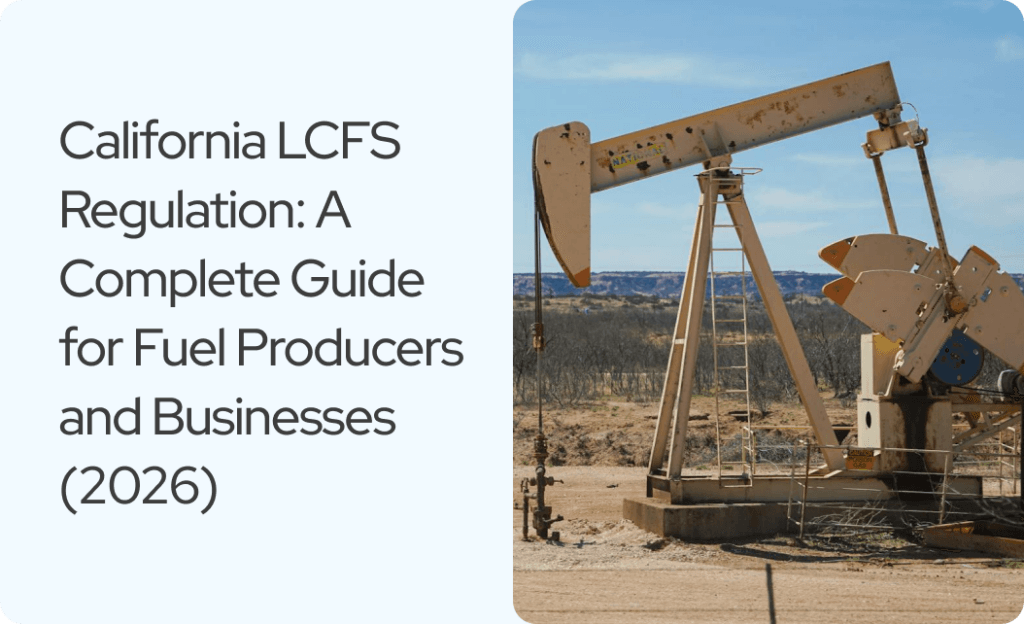
The California LCFS regulation — formally known as the Low Carbon Fuel Standard — is one of the most impactful clean fuel policies in the United States. Administered by the California Air Resources Board (CARB), the LCFS regulation requires transportation fuel producers and importers to reduce the carbon intensity of the fuels they sell in California. For anyone operating in fuel production, clean energy, or transportation, understanding this regulation is no longer optional — it is a compliance and business imperative.
Whether you are a fuel producer, fleet operator, electricity provider, or policy professional, this guide explains how the California LCFS regulation works, who it affects, how credits and deficits are generated, and what compliance looks like in practice. We also cover the latest 2025 and 2026 developments and what businesses should be doing now to stay ahead.
The California Low Carbon Fuel Standard (LCFS) is a state-level regulation established by the California Air Resources Board in 2011 under the authority of AB 32 — California’s landmark climate change law. The LCFS regulation sets a carbon intensity (CI) standard for transportation fuels sold or used in California. Its goal is to reduce the lifecycle greenhouse gas emissions associated with transportation fuel consumption by 20% below 2010 levels by 2030.
Unlike a carbon tax, the LCFS regulation operates as a market-based performance standard. Fuels with a lower carbon intensity than the annual benchmark generate credits, while fuels with a higher carbon intensity incur deficits. Regulated parties must either stay below the benchmark or purchase credits from those who generate surpluses.
| 20% | LCFS GHG reduction target below 2010 baseline — required by 2030 |
The regulation covers virtually all transportation fuels used in California — from gasoline and diesel to electricity, hydrogen, renewable natural gas, ethanol, and biomass-based diesel. This wide scope makes the California LCFS regulation one of the most comprehensive clean fuel policies in the US.
Carbon intensity (CI) is the measure at the heart of the California LCFS regulation. It quantifies the lifecycle greenhouse gas emissions associated with a unit of fuel energy — expressed in grams of CO2-equivalent per megajoule (gCO2e/MJ). This lifecycle calculation spans feedstock extraction, fuel production, transportation, distribution, and combustion.
Each year, CARB sets a CI benchmark that declines over time. Fuels with a CI score below the benchmark generate LCFS credits. Fuels above the benchmark generate deficits. The gap between a fuel’s actual CI and the benchmark determines how many credits or deficits are assigned per unit of energy.
Indicative CI scores across common California fuel types (2026)
The 2026 LCFS CI benchmark sits at approximately 85 gCO2e/MJ (declining annually toward 80 by 2030). Fuels below this threshold generate credits; fuels above it generate deficits.
Fuel Type | Approx. CI Score (gCO2e/MJ) | LCFS Position |
| Gasoline (baseline) | ~99 | Deficit generator |
| Diesel (baseline) | ~100 | Deficit generator |
| Corn ethanol (average) | ~60–70 | Credit generator |
| Renewable diesel (tallow feedstock) | ~20–35 | Strong credit generator |
| Grid electricity (CA average) | ~25–40 | Credit generator |
| RNG from landfill gas | ~-30 to -50 | Strong credit generator |
| Green hydrogen (electrolysis) | ~0–10 | Strong credit generator |
Note: CI scores vary by CARB-certified production pathway. Values shown are indicative ranges only.
The California LCFS regulation applies to a broad range of parties who produce, import, or supply transportation fuels in California. Understanding your regulatory status is the first step toward compliance.
Obligated parties are fuel producers and importers who must meet the CI standard for the volumes they sell or use in California. These include:
Any party that produces or supplies a fuel with a CI score below the annual benchmark generates LCFS credits. Credit generators can be third-party producers who sell credits into the market, even if they are not themselves obligated parties. Common examples include:
The California LCFS regulation operates through a credit and deficit accounting system. Each LCFS credit represents one metric tonne of CO2-equivalent reduction achieved by using a fuel below the annual CI benchmark. Each deficit represents one metric tonne of CO2-equivalent excess above the benchmark.
The calculation is: the difference between the annual CI benchmark and the fuel’s certified CI score, multiplied by the energy content of the fuel volume supplied, yields the number of credits or deficits generated. Regulated parties must ensure their total deficits are fully offset by credits by the end of each compliance period.
Key LCFS credit market facts
| Credit market characteristic | Detail |
| Unit of trade | 1 LCFS credit = 1 metric tonne CO2e reduced |
| Historical price range | Approximately $50–$200+ per credit (2018–2024) |
| Where credits trade | CARB’s LCFS Credit Clearance Market (CCM) and bilateral trades |
| Annual compliance deadline | March 31 of the following year |
| Banking allowed? | Yes — unused credits can be banked indefinitely |
| Borrowing of future credits? | No — deficits must be offset with existing credits |
Compliance with the California LCFS regulation requires regulated parties to monitor fuel volumes and CI scores, register with CARB, report quarterly, and ensure deficits are fully offset with credits by the annual deadline. Here is how the process works in practice.
All regulated parties must register in CARB’s LCFS Reporting Tool (LRT). This includes completing a regulated party registration, identifying your fuel pathways, and providing baseline fuel supply data. Credit generators who are not obligated parties must also register if they wish to generate and sell credits.
Every fuel sold under the LCFS regulation must have a CARB-approved CI score certified through a registered fuel pathway. Producers can use CARB’s Tier 1 lookup table for common pathways or apply for a Tier 2 pathway for fuels with unique production characteristics. Accurate lifecycle analysis is critical — errors in pathway applications are a leading cause of compliance failures.
Regulated parties submit quarterly reports through the LCFS Reporting Tool, documenting fuel volumes, CI values, and calculated credits or deficits. Reports are subject to CARB audit and must be backed by primary documentation, including fuel delivery records, feedstock receipts, and third-party verification for certain pathway types.
By March 31 of each year, regulated parties must submit sufficient LCFS credits to offset all deficits accumulated in the prior calendar year. Credits can be sourced from internal generation, purchased bilaterally, or acquired through CARB’s Credit Clearance Market. Failure to offset deficits results in enforcement actions and financial penalties.
The California LCFS regulation is not static — CARB periodically reviews and amends it to align with California’s evolving climate goals. Several significant changes have shaped the regulation in recent years.
Following CARB’s 2022 rulemaking, the carbon intensity reduction requirement was increased to 20% by 2030 — up from the original 10% target. This means the annual CI benchmark will decline more steeply, generating more deficits for fossil fuel providers and increasing the value of low-CI fuels and credit generation over time.
CARB has expanded the range of eligible fuel pathways, including provisions for sustainable aviation fuel (SAF), new hydrogen production methods, and carbon capture utilization and storage (CCUS) pathways. These expansions allow producers to claim additional CI reductions based on carbon capture at the production facility, creating new credit generation opportunities.
The updated LCFS regulation includes stricter data verification requirements for certain fuel types — particularly biomethane and biogas pathways — including third-party audit provisions for feedstock sourcing and GHG calculations. Businesses relying on these pathways should review their verification obligations under the current rule.
The California LCFS regulation is not only a compliance obligation — it is a significant commercial opportunity for businesses that position themselves correctly. As the CI benchmark tightens annually, the value of low-carbon fuel production and credit generation grows correspondingly.
Producers of renewable natural gas, renewable diesel, electricity for EVs, and hydrogen can generate substantial LCFS credit revenue. Dairy and agricultural biogas projects in California have leveraged the LCFS regulation to monetize negative-CI biomethane credits, generating multi-million dollar annual revenues from waste streams that previously had no commercial value.
Businesses that own or operate EV charging infrastructure for commercial fleets can generate LCFS credits for every kilowatt-hour of electricity they provide. This makes the LCFS regulation a powerful financial incentive for accelerating fleet electrification — particularly for logistics, transit, and municipal fleet operators across California.
Oregon (through the Clean Fuels Program) and Washington (through the Clean Fuels Standard) have adopted similar low carbon fuel standard frameworks modeled on California’s approach. Experience gained navigating the California LCFS regulation positions businesses favorably for compliance in these growing adjacent markets.
Compliance Tips: Navigating California LCFS regulation effectively
✓ Register with CARB’s LCFS Reporting Tool well before your first compliance period — registration delays cause reporting backlogs
✓ Certify your fuel pathway early; Tier 2 pathway applications can take 6–12 months to receive CARB approval
✓ Keep primary documentation — delivery records, feedstock receipts, energy data — for a minimum of 3 years to support CARB audits
✓ Monitor LCFS credit prices and consider banking surplus credits when prices are low to hedge against future deficit costs
✓ If you supply biomethane or RNG, verify your feedstock eligibility and any third-party audit requirements under the updated rule
✓ Track quarterly reporting deadlines closely — late submissions attract penalties even if your credit balance is positive
✓ Invest in digital compliance platforms to automate data collection, CI calculations, and reporting to reduce errors and staff burden
The California LCFS regulation is one of the most significant and commercially impactful clean fuel policies in the United States. From CI scoring and credit generation to quarterly reporting and annual deficit settlement, navigating the regulation effectively requires both a solid understanding of the framework and reliable systems for data management and compliance tracking.
As the annual CI benchmark continues to tighten toward the 2030 target, the stakes for obligated parties rise and the revenue opportunity for low-carbon fuel producers grows. Whether you are a regulated fuel importer, a renewable fuel developer, or a fleet operator looking to generate credits through EV charging, the time to get your LCFS compliance strategy right is now.
Platforms like Carboledger are purpose-built to help fuel producers and regulated parties manage their LCFS compliance — automating carbon intensity calculations, credit tracking, pathway documentation, and CARB reporting submissions in one place. If you are ready to simplify your California LCFS regulation compliance, start by auditing your current fuel pathways and data systems today.
The California Low Carbon Fuel Standard (LCFS) is a regulation administered by CARB that requires transportation fuel producers and importers to reduce the carbon intensity of fuels sold in California. It uses a credit and deficit market — lower-carbon fuels generate credits, fossil fuels generate deficits, and obligated parties must offset deficits annually.
The California LCFS regulation applies to producers and importers of transportation fuels sold or used in California, including gasoline, diesel, ethanol blenders, natural gas providers, and electricity suppliers to public EV charging networks. Parties supplying above 3.6 million gasoline-gallon equivalents per year are typically obligated parties who must report and offset deficits.
LCFS credits are generated when a fuel’s certified carbon intensity score falls below CARB’s annual CI benchmark. The credit volume equals the CI difference multiplied by the fuel’s energy content. Fuels such as renewable natural gas, renewable diesel, grid electricity, and hydrogen commonly generate LCFS credits due to their low lifecycle greenhouse gas emissions.
Following CARB’s 2022 rulemaking update, the California LCFS regulation now requires a 20% reduction in average fuel carbon intensity by 2030 compared to the 2010 baseline. The annual CI benchmark declines each year to track toward this goal, making compliance increasingly demanding for fossil fuel providers and more valuable for low-CI fuel producers.
Companies that fail to offset their LCFS deficits by the March 31 deadline face enforcement actions from CARB, including financial penalties and corrective action plans. CARB can subject non-compliant parties to enhanced reporting and auditing obligations, and persistent non-compliance can result in suspension of fuel pathway certifications and trading privileges.